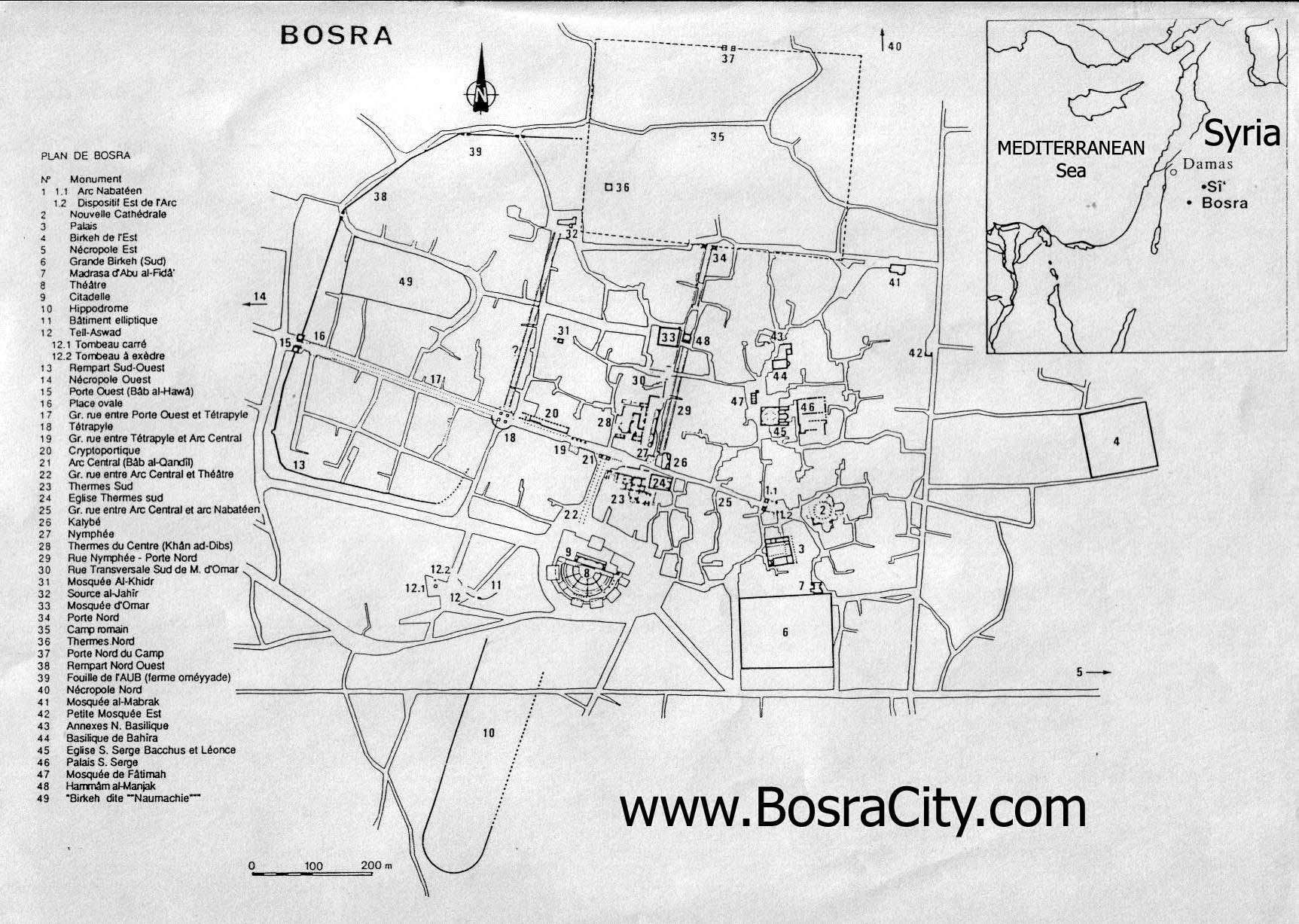
This ancient place is the largest of all the ruined cities in the region of the Haurân, and in all the country south of Damascus and east of the Jordan. It was also the site of the largest inhabited town in all this neighbourhood until the completion of the Hedjaz railway, when a new lease of life was given to some of the villages along the line on the opposite side of the plain; but it still remains the chief town of the Haurân proper. Bosra lies on the eastern edge of the great Haurân plain just at the southwestern foot of the Haurân mountains (See
Map of Southern Haurân, II, A, 2). It is about 73 miles south of Damascus and 90 miles northeastward from Jerusalem. To the north and west of the ancient city, and for a short distance to the south, spread the fertile fields of Syria's chiefest granary, en-Nukra, "the Hollow" of the Haurân ; to the east slopes of the Djebel Haurân, carrying the eye aloft to the summit of the steep conical hill which is crowned by the castle of Salkhad. Bosra itself is elevated a little above the plain, and the fields to the east begin at once to rise towards the foot hills of the mountains. From a considerable distance, in almost every direction, the castle walls and the minarets of the mediaeval city provide a bold skyline which suggests a city of some importance, and the dull black basalt of which these buildings are made creates a striking contrast with the bright green or gold of the plain, and the blue of the hills beyond. The town is easily approached today from all points of the compass; but, in ancient times, no less than five Roman highroads, broad and well paved, converged towards the city, carrying the commerce of Arabia into its warehouses and taking it forth again to the north and west. Two of these roads led out to the north, one of them leading direct to Damascus across the Ledja, curving a little towards the east. The other, running to the west of the true north, was perhaps another road to Damascus, avoiding the Ledja and passing through the ancient cities of Aere and Zorava, or it may have led clown to Sidon on the sea coast by way of Caesaraea Paneas; but its course has not been definitely traced far beyond the city limits. The third road, that leading to the west, and well marked between Bosra and Der'a, ancient Adraa, was undoubtedly the direct route to the sea, to Sycaminunt near the present port of Haifa, by way of Gadara and Scythopolis, though this ancient road has not been traced from point to point. The road to the south was the great route constructed by the Emperor Trajan from Bostra to the Red Sea , and which is still to be followed from milestone to milestone as far as Philadelphia. The fifth road which may be seen in a straight line mounting the slopes toward Salcha , turns to the southeastward from that point, and penetrates the desert in the direction of the Persian Gulf. Thus it will be seen that the capital of the Arabian Province was no mere wayside town on some great artery of the commerce of the empire; but the centre, or hub, of an extensive system of highroads, which commanded the traffic of this wide southeastern boundary of Rome's world-wide domain. The location of Bostra fitted the city in more ways than one to become a great metropolis; for, in addition to its command of the wealth of a broad and fertile plain, and of important routes of trade, the city was well supplied with water, not only by the neighbouring streams which are fed by the melting snows of the Djebel Haurân for a goodly portion of the year, but by numerous springs, within and without the walls, which perennially gush pure, clear, cold water even in these days of extraordinary dryness throughout all Syria and Arabia l. Since Bosra, as I have said above, is still the most important town in the great area to the southeast of Damascus, and was in Imperial times the largest of the Roman cities in this part of the world, there can be little doubt that the site is one of great antiquity, to be compared perhaps with the ancient city of Damascus. Whether the Bosra of to-day was the Bozrah of the Prophet Jeremiah's2 cursing or not, judgment seems to have "come upon the plain country and upon Bozrah, and all the cities of the land of Moab, far and near", and it seems quite probable that this site is as old as any on the east of Jordan. The place was certainly a stronghold in the first quarter of the second century before Christ; for Judas Maccabaeus3 came to the place after his campaign against the Ammonites. It was an important centre of Greek life at this period and had probably been such since the days of Greek colonization which followed upon the conquests of Alexander the Great and his successors in Syria. It is said to have been a later member of the Decapolis ; but, soon after the beginning of. the first century B. C, it must have come into possession of the Nabataeans who at this time had extended their power' well up into the Auranitis. It is certain that after Pompey's conquests in this part of Syria, in 64 B. C, Bostra remained the northern limit of the Nabataean dominions. In St. Paul's time Bostra was a Nabataean city, for the Arab kingdom embraced even Damascus in his day, and Nabataean it must have remained, 200 years or more in all, until Cornelius Palma conquered all this part of the world for Rome in the name of Trajan, and, in the year 106 after Christ, made this city the capital of the newly formed Province of Arabia. As a Roman city Bostra flourished anew, was especially favored by the Antonine emperors, by Septimius Severus, Severus Alexander, and by Philip the Arab. The coins struck by the city are an index of its periods of advancement; these are described in an Appendix attached to this Part. The city was important as a stronghold of the early Church, and here Origen 5 came, about 245 A. D., to debate with Beryllus, bishop of Bostra. The sixth century saw the erection here of one of the greatest cathedral churches in all Syria and Arabia; and, later in the same century, it is said, the camel-driver Mohammed came to the city from the far south, and from a Christian monk, Bahira by name, learned all he knew of the tenets of Christianity. In the following century, in the year 632, Bostra fell to Khalid and the Moslems. During the Middle Ages the city flourished as one of the important cities of Islam ; in the midst of the town several mosques were built, the minarets of five of which still impart a mediaeval character to the ruins, and a strong castle, one of the largest in this part of the world, was erected upon the Roman theatre out of materials torn from the Roman walls and colonnaded streets. A number of the Arab geographers 1 refer to Bosra, and one of them compares its castle with that at Damascus. The great Pilgrim Road to Mecca passed through the town for many centuries, and here the great caravan halted for several days. After the Pilgrim Road was changed to a route farther west the decline of the Arab city began. A few generations ago it was almost deserted; even now only one of its mosques is in use, and the poor modern village occupies only a small fraction of the area within the limits described by the ancient walls. Bosra has been visited frequently during the last century. Some idea of the large number of visitors who have referred to the ruins in books may be had by looking through Professor Brunnow's exhaustive bibliography of the books of travel touching the Province of Arabia, and noting.-the" frequent references to Bosra. The work of the earliest traveller to make important notes on the ruins was not the first to be published. Seetzen went to Bosra in the course of an extended journey in Syria in 1805—1807; but the account of his travels* was not published until after 1850. Burckhardt was in Bosra in the spring of 1812, and the results of his journey were published in 1822. Richter., who visited the ruins in 1815, was the first to publish plans and pictoral illustrations of the ancient buildings. Buckingham reached Bosra, in the course of his wide travels, in 1816, and makes several references to the ruins in his book of travel; Berggren came here in 1821. In 1827 Count Leon de Laborde made notes and drawings here which were published in 1837. Lord Lindsay made his visit in 1837, and Monk came in 1849. Porter, who first arrived in Bosra in 1853, published a sketch plan of the city and a number of illustrations of its ruins. Rey brought out a far better plan, on a larger scale, and published several large drawings of buildings and of Arabic inscriptions which he made in 1857. In the same year Graham made a few notes on Bosra, and a year later the Prussian Consul Wetzstein passed through the ruins taking a few notes. The first of the architecture of the ancient city was made by the Count de Vogue in 1861, but his researches were confined to the Cathedral, though he published a drawing of the Theatre. In 1875 the American Consul Merrill reached Bosra; and in 1877 Thomson made some observations. Oppenheim and Heber-Percy came in 1893; both published photographs of the ruins. During the next year Schumacher was twice in Bosra. In 1898 Brunnowcarried on the researches that resulted in the first extensive study of the architecture of Bosra. Dussaud and Macler passed, in quest of inscriptions, in 1899 and again in 1901. Kondakow also was here in 1901, and published some excellent photographs of the ruins, and Puchstein spent two days here measuring the ruins in 1902; but his untimely death has prevented the publication of his results so far as Bosra is concerned. The above list, long as it is, includes only the names of archaeologists, and of travellers who have published notes or drawings or photographs of greater or less importance archaeologically speaking, but does not include the names of a large number of visitors who have made no more than passing mention of the ruins in the journals which have been published. This much larger list, as I have said above, is to be had by checking off the mention of Bosra in the bibliography so carefully prepared by Professor Brunnow for his Pro-vincia Arabia . The history of ancient Bostra is quite plainly written in its monuments; although excavations would serve to furnish many details and to fill in numerous gaps in that history. The " cyclopaean" walls at the southwest end of the ruins are evidence of
the city's great age. The Nabataean period of its history is represented in a number of engaged columns of large scale that have capitals characteristic of the early architecture at Petra und Sî, and in numerous fragments of carving, like that shown in I11. 198, Bosra which are purely Nabataean, to say nothing of the large number of Nabataean inscriptions and coins of that Oriental kingdom. A transition, one might say, in the architecture of Bostra is to be seen in one of the arches which presents details that partake of both Nabataean and Roman elements. It might have been either a triumphal arch built for some Nabataean king after Roman influence had begun to press upon the Haurân on two sides, or it might have been a Roman memorial of the founding of the Arabian Province, built by Nabataean architects in imitation of Roman arches. It is rather difficult, for lack of inscriptions, to assign any of the buildings definitely to the reigns of Trajan or Hadrian, though a building called the Palace, and the Theatre, both show some early features. The city gates might belong to any Roman period. There are fragments among the agglomeration of native houses on the high ground which might be called the akropolis, which resemble architectural details of Hadrian's reign; but it is probable that Bostra , in company with all the other cities of Syria, saw a great period of temple building under the Antonine emperors. The. four imposing columns which I have designated as belonging to a Nymphaeum might have belonged to this period. But some of the monuments are plainly later. One well known triumphial arch bears an inscription which is believed to be later than the middle of the third century ; but the structure itself, especially its lower half, may well date from a period much older than the inscription which was merely the dedication of a statue placed upon one of the consoles of the arch. The greatly elongated columns of the "Kalybe", and other features of that building, indicate that it belongs to one of the later periods of Roman architecture. The great masonry structures, like the Baths and the Market, are also probably to be assigned to the third century, or perhaps even to the fourth. It would be difficult to assign even approximate dates to the basilical churches; they might easily be structures of the fourth or fifth century, or they might belong to the sixth. The Cathedral which is dated early in the sixth century is one of the finest specimens of Christian architecture in all Syria. It is interesting to observe that in all the buildings of the various periods enumerated above, the treatment of design and of architectural details is allied with the architecture of corresponding dates in the Djebel Haurân, and, I might say, with the architecture of the cities of the Decapolis, as opposed to the architecture of Umm idj-Djimâl and the towns of Southern Syria. In other words, it has more of the Classical and less of the Native characteristics. One cannot but suspect that this is due, in part at least, to a large number of Greek artists and artisans who may be presumed to have helped to make up the population of Bostra as a city closely allied with, and perhaps a member of, the Greek confederation. In all matters that have to do with construction too, the buildings of Bosra, as they stand today, are on the whole illustrative of Hellenistic principles as opposed to those very marked characteristics which give individuality to the architectural style of the Haurân. Some of the earlier visitors seem to have been impressed to the contrary ; they write as if the ancient buildings to be seen in their day were almost exclusively examples of the Haurânian style. Now if by "the style .... observed in all the other ancient towns of the Haouran" is meant the use of girder arches carrying roofs of stone slabs, which is the only architectural feature common to all these ancient towns , Division II Section A Part 4 one must beg leave to point out that the state of the ruins must have changed very materially ; for the arch-and-slab principle of construction is to be observed today in a very small number of the buildings of Bosra, in the Palace so-called, and in a small number of ancient houses. The important edifices, with hardly an exception, conform either to the Classical, trabeated, architecture of the column and entablature, to the distinctly Roman style which combined arched construction with columnar decoration -like the triumphal arches -, or to the great principle of the dome and vault which, whether it is to be looked upon as Roman or as Oriental, is certainly not typical of the style of the Haurân. When one takes up the study of the mosques, he is astonished to find that, in these erections of the Middle Ages, the style of the Haurân does obtain; for the majority of these buildings were constructed on the principle of the girder arch and the roof of stone slabs. It is always difficult to determine the age of buildings that are composed of second-hand material, and the Mosques of Bosra were built almost entirely of materials, and decorated with details, that were plundered from Roman and Christian edifices. The fall of Bosra to the Moslems gives the earliest possible date, and the beginning of the decline of the Arabic city in the seventeenth century suggests the probable latest; but, aside from the one or two buildings that are dateable by reference to inscriptions, the Moslem architecture of Bosra cannot be brought into any definite chronological scheme. One might remark, in passing, that comparatively few of the modern houses of Bosra conform to the style of domestic architecture now most prevalent in the modern villages of the Haurân, which is a crude adaptation of the ancient style of arches and slabs.
 Sniper Elite game, is one of the most popular and awesome games. Sniper Elite is the ultimate sniper simulator. Caught between the Soviets and Germans in war-torn Berlin, you control the fate of a lone American OSS Sniper. Adjust for gravity, wind, posture, breathing, and more when you take your shot. Take advantage of your environment in everything from cover, to position to sound masking in 28 heart pounding single player missions and in tense eight player online sniper battles like you've never seen before. it is really worth to try and play, especially when play the online game, you will really explore by yourself how the game is interesting and how beautiful it is.